
How to Read a Safety Data Sheet (SDS)
Safety Data Sheets (SDSs) contain critical information for handling workplace chemicals safely, but in an emergency or during routine pre-job planning, a document is only as useful as your ability to find what you need quickly. This course demystifies the standardized 16-section SDS layout, equipping you with the practical skills to locate vital chemical hazards, required PPE, and life-saving first-aid instructions without wasting a second.
By: Safety LMS | Format: Online | Duration: 1 hour | Certification: 24 Months | Language: EnglishWhat you'll learn
SDS Fundamentals & Purpose: Understand what an SDS is, how it fits into OSHA and WHMIS Hazard Communication standards, and why global standardization matters.
The Standard 16-Section Architecture: Master the layout and sequence of all 16 sections, knowing exactly which category holds the answer to your question.
Hazard & Precaution Identification: Rapidly interpret chemical classification, pictograms, signal words, and hazard statements in Section 2.
Protective Measures & Exposure Controls: Locate Permissible Exposure Limits (PELs), engineering controls, and mandatory personal protective equipment in Section 8.
Safe Handling & Chemical Compatibility: Identify safe storage rules, environmental limitations, and reactive chemical incompatibilities in Section 7 and Section 10.
Emergency Response Execution: Instantly navigate to immediate first-aid steps, accidental release clean-up protocols, and fire-fighting measures during a spill or exposure.
Description
Working with or around hazardous chemicals requires immediate access to accurate safety data. When a drum begins leaking, a line splashes, or a new chemical product arrives on the loading dock, a multi-page technical document is useless if you don't know where to look. An SDS is designed to protect your health and prevent facility disasters, but its real-world value depends entirely on your ability to retrieve critical information under pressure.
This course breaks down the Globally Harmonized System (GHS) 16-section format into logical, practical clusters: Identification and Hazard Classification (Sections 1–3), Emergency Response Procedures (Sections 4–6), Daily Handling and Exposure Prevention (Sections 7–11), and Technical/Regulatory Reference (Sections 12–16). You will learn how each section builds upon the container's GHS label, enabling you to bypass complex chemical terminology and immediately zero in on the relevant safety controls.
The Golden Rule of Chemical Safety: You should never read an SDS for the first time after an exposure occurs. Reviewing chemical hazards, required PPE, and emergency steps before opening a container is the foundation of proactive workplace safety.
Beyond emergency response, the training emphasizes day-to-day operational use. You will explore how to check Section 8 before selecting gloves or respirators, verify chemical compatibility in Section 10 before placing substances in the same storage cabinet, and review Section 13 to ensure compliant, environmentally sound disposal. By the end of this course, you will be able to navigate any Safety Data Sheet with speed and confidence, turning raw chemical data into actionable, life-saving workplace protection.
Course topics
- Hazard Communication Basics
- What Is an SDS?
- When Would You Use an SDS?
- How an SDS Is Organized
- Sections 1 Through 4
- Sections 5 Through 8
- Sections 9 Through 11
- Sections 12 Through 16
- Before You Start the Job
- PPE, Exposure Controls, and Good Work Practices
- Handling, Storage, and When Something Goes Wrong
- When SDSs Come Into Play
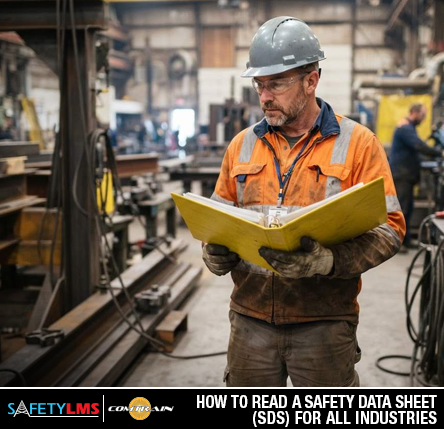
The 16-Section Interactive Map: A quick-reference navigation guide detailing the exact structure and purpose of every standardized GHS-aligned section.
Emergency Info Fast-Finder: Practical speed drills focused on locating critical Section 4 (First-Aid) and Section 5 (Fire-Fighting) details during chemical incidents.
PPE & Control Matcher: Guided exercises on cross-referencing Section 8 (Exposure Controls/Personal Protection) with specific jobsite tasks and handling procedures.
Real-World SDS Scavenger Hunt: Applied scenario drills testing your ability to extract compatibility, handling, and disposal rules from authentic chemical manufacturer sheets.
See more...