
Trailer/Towing Safety
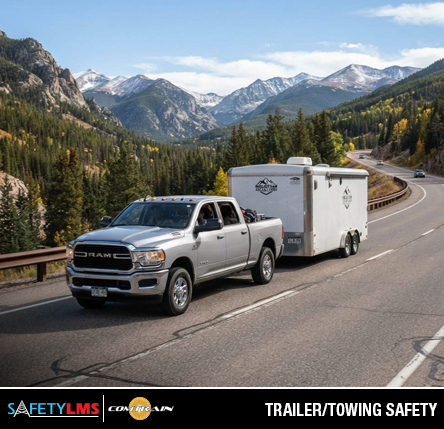
Towing a trailer turns a standard vehicle into a heavy, multi-articulated combination rig with unique physics and handling characteristics. This course covers everything from tongue weight calculations and hitching mechanics to highway speed control and emergency recovery, ensuring your load arrives safely every time.
By: Safety LMS | Format: Online | Duration: 2 hours | Certification: 24 Months | Language: EnglishWhat you'll learn
-
Towing Capacity & Compatibility: Verify gross vehicle weight ratings (GVWR), gross combined weight ratings (GCWR), and payload limits.
-
Hitching & Connection Rigor: Master safe coupler locking, safety chain crossing, breakaway switch setup, and light/brake testing.
-
Proper Loading & Weight Distribution: Position cargo to achieve optimal tongue weight and avoid dangerous rear-heavy instability.
-
On-the-Road Dynamics: Adjust speed, braking distance, turning radius, and lane changes to account for added length and mass.
-
Maneuvering & Reverse Operations: Apply specialized techniques for backing up, navigating tight spaces, and secure parking.
-
Emergency Actions & Troubleshooting: Identify developing hub or tire failures, handle trailer separation threats, and execute safe sway recovery.
Description
Towing a trailer isn't as simple as dropping a coupler onto a ball and hitting the gas. Attaching thousands of pounds of rolling cargo behind a vehicle completely alters acceleration, braking distances, center of gravity, and handling dynamics. A single error in hitching or uneven weight distribution can trigger violent trailer sway, catastrophic uncoupling, or severe rollover accidents. This course provides drivers and operators with a rock-solid operational discipline for every stage of towing.
We begin before the engine ever starts: verifying tow vehicle ratings, hitch classifications, and trailer compatibility. You’ll explore the science of tongue weight and cargo securement, learning why placing too much weight behind the trailer axles creates a dangerous pendulum effect that can wrench control from the driver. We dive deep into pre-trip inspections, walking step-by-step through hitch connections, safety chains, wiring harnesses, and electric brake controllers.
The Golden Rule of Towing: Respect the ratings and balance the load. A proper hitch connection and a balanced 10%–15% tongue weight are your best defenses against trailer sway.
Once on the road, the training focuses on dynamic handling and situational awareness. You will learn how to manage extended stopping distances, execute wide turns without clipping curbs, and navigate high-wind zones or passing highway traffic. Finally, we tackle low-speed maneuvering—mastering backing techniques and secure parking—alongside critical emergency responses for tire blowouts or mechanical failures. By the end of this course, you will have the technical confidence to transport equipment and cargo safely on every job.
Course topics
- Trailer and Towing Basics
- Tow Vehicle and Trailer Compatibility
- Pre-Use Inspection
- Hitching and Connecting the Trailer
- Loading and Securing Cargo
- Safe Towing and Vehicle Operation
- Backing, Parking, and Unhitching
- Towing Hazards and Emergency Situations
-
Tongue Weight & Distribution Calculator: Visual tool to calculate ideal tongue weight (10%–15% of total gross trailer weight) to prevent dangerous sway.
-
The Hitching Checklist & Visualizer: Interactive walkthrough of ball mounts, pintle hooks, safety chains, emergency breakaway cables, and electrical pinouts.
-
Cargo Securement Grid: Step-by-step guidance on working load limits (WLL), tie-down angles, and ratchet strap ratings.
-
Trailer Sway Recovery Guide: Tactical decision framework on managing wind gusts, passing semi-trucks, and dynamic sway without panicking.