
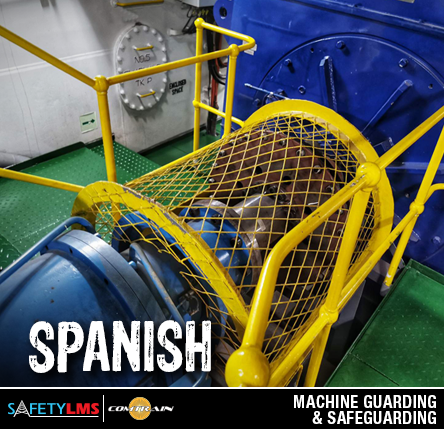
Machine Guarding / Safeguarding (Spanish)
Moving machinery parts don't offer second chances. This course provides workers, supervisors, and maintenance personnel with the essential knowledge needed to recognize machine hazards, inspect safeguards, and prevent life-altering contact with power transmission components, pinch points, and points of operation
By: Safety LMS | Format: Online | Duration: 2 hours | Certification: 24 Months | Language: SpanishWhat you'll learn
-
Hazard & Motion Recognition: Identify pinch points, rotating shafts, reciprocating components, and hazardous points of operation.
-
Guard Types & Limitations: Understand the mechanics, advantages, and physical limitations of barrier guards and safeguarding devices.
-
Pre-Op Safeguard Verification: Learn how to inspect and confirm that all guards are properly installed, functional, and untampered with.
-
LOTO Integration: Recognize when servicing, cleaning, or removing guards requires full Lockout/Tagout isolation to prevent unexpected energization.
-
Deficiency Reporting & Stop Work: Master protocols for reporting damaged or bypassed guards and exercising Stop Work Authority in unsafe conditions.
Description
Industrial machinery powers modern production, but exposed gears, rotating shafts, and cutting points present constant, unforgiving hazards. A missing guard or a bypassed safety interlock can turn routine machine operation into a severe crushing or amputation event in a fraction of a second. This course provides a comprehensive safety framework designed to protect operators, supervisors, and maintenance teams from contact with hazardous moving parts.
We begin by deconstructing industrial equipment to identify three primary hazard zones: the point of operation, power transmission systems, and auxiliary moving parts. You will explore the full spectrum of physical guards and safety controls—learning how fixed, interlocked, and presence-sensing devices function to keep hands and bodies away from danger.
The Golden Rule of Safeguarding: If a guard must be removed or bypassed to clear a jam, perform maintenance, or make adjustments, the machine must be locked out—never rely on an open guard or interlock during servicing.
Beyond standard machine operation, the training focuses on proactive hazard control. You will learn how to conduct thorough pre-start inspections to ensure safeguards are correctly positioned and fully operational. Finally, the course emphasizes your critical role in maintaining site safety, teaching you how to report compromised equipment and exercise your Stop Work Authority whenever conditions are uncertain or unsafe. By the end of this course, you’ll have the knowledge and confidence to keep your equipment compliant and your workplace injury-free.
Course topics
- Machine Guarding Fundamentals
- Machine Hazards and Danger Zones
- Guarding Requirements and Responsibilities
- Types of Machine Guards
- Safeguarding Devices and Systems
- Safe Machine Operation
- Guard Removal, Adjustment, and Servicing
- Lockout/Tagout and Unexpected Startup
- Inspections and Guarding Deficiencies
- Reporting Hazards and Preventing Recurrence
-
Interactive Danger Zone Map: Visualizations of points of operation, power transmission apparatus, and pinch/nip points across common industrial machinery.
-
Safeguard Classification Toolkit: A guide detailing fixed, interlocked, adjustable, and self-adjusting guards, alongside presence-sensing devices like light curtains and pressure mats.
-
Pre-Op Safeguard Checklist: Digital inspection templates to verify guard placement and functional integrity before machine startup.
-
LOTO Boundary Matrix: Clear guidelines on when routine operational adjustments cross over into Lockout/Tagout (LOTO) requirements during servicing and maintenance